All-on-4 and All-on-6 both replace a full arch of teeth with a fixed bridge on dental implants. The difference is the number of implants: four or six per jaw. All-on-4 needs less bone and often avoids bone grafting, while All-on-6 spreads the biting load across more implants for extra support. The right choice depends mainly on your bone, your bite and your budget, and your dentist will recommend the option your jaw can best support.
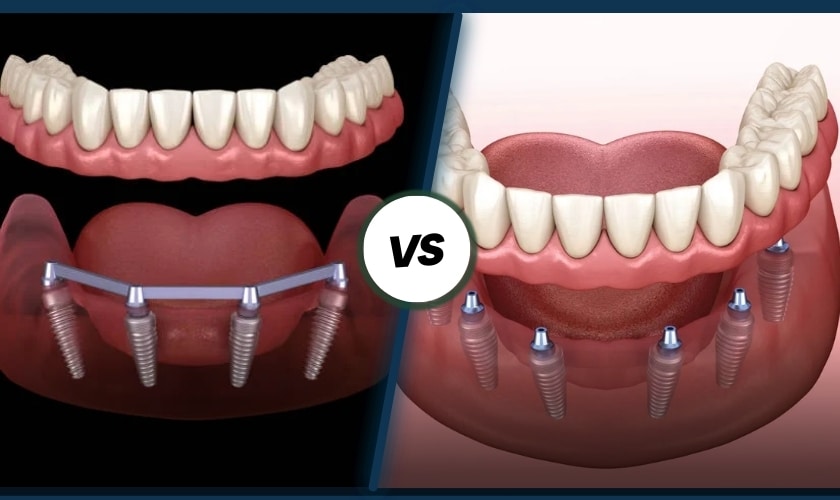
Side-by-side comparison
| All-on-4 | All-on-6 | |
|---|---|---|
| Implants per jaw | 4 | 6 |
| Bone needed | Less; back implants are angled to use available bone | More bone volume across the arch |
| Bone grafting | Often avoided | More likely if bone is thin |
| Load distribution | Good | Spread across more implants |
| Backup if an implant fails | Less margin | More margin |
| Implant-phase cost per jaw | Lower end of range | Upper end of range |
| Best for | Moderate bone loss, avoiding grafts | Good bone, strong bite, upper jaw |
How All-on-4 works
Two implants are placed upright at the front of the jaw, and two are angled at the back. The angled implants make use of denser bone at the front and avoid the sinuses in the upper jaw and the nerve in the lower jaw. This often means patients with bone loss can have fixed teeth without a bone graft.
Advantages: fewer implants, often no bone graft, lower implant-phase cost and a shorter surgery.
Considerations: each implant carries more of the biting load, so there is less margin if one implant has a problem.
How All-on-6 works
Six implants are spread along the arch, giving the bridge more points of support. This is often preferred for the upper jaw, where bone is softer, and for patients with a strong bite or who grind their teeth.
Advantages: extra stability, load shared across more implants, and more redundancy over the long term.
Considerations: needs more bone, may need grafting, and costs more in the implant phase.
Cost per jaw at Melrose Advanced Dentistry
| Phase | All-on-4 | All-on-6 |
|---|---|---|
| Implant phase | From R52,000 | Up to R78,000 |
| Prosthodontic (rehab) phase | R100,000 to R200,000 | R100,000 to R200,000 |
The implant-phase fee depends on the number of implants, and the rehab-phase fee depends on the design and material of your final bridge. We claim directly from your medical aid for all implant procedures, and we provide in-house sedation.
[Editor’s note: confirm that the R52,000 and R78,000 figures correspond to four and six implants, and how five implants are priced.]
Which should you choose?
All-on-4 may suit you if you have moderate bone loss, want to avoid bone grafting, or want a lower implant-phase cost. All-on-6 may suit you if you have good bone volume, need an upper-jaw restoration, grind your teeth, or want the extra security of more implants.
The decision is a clinical one. A 3D scan shows exactly how much bone you have and where, so we can recommend the number of implants that will give you the most stable, long-lasting result.
Frequently asked questions
Is All-on-6 better than All-on-4? Not always. With enough bone, six implants give more support. With bone loss, a well-planned All-on-4 can avoid grafting and still last many years.
Can I start with All-on-4 and add implants later? It’s sometimes possible, but it’s better to plan the right number from the start.
Do the final teeth look different between the two? No. Both support the same kind of fixed bridge. The difference is underneath.
Is the surgery longer for All-on-6? Slightly, because more implants are placed. Both are done with in-house sedation or under general anaesthetic.
Not sure which option suits you? Book a full-arch implant consultation at Melrose Advanced Dentistry in Melrose, Johannesburg: call 072 200 1774 or visit advanced-dentistry.co.za.