Clear aligners are removable, nearly invisible plastic trays that straighten teeth in stages, while braces use fixed brackets and wires. Aligners suit mild to moderate crowding and spacing in disciplined patients. Braces handle complex bite problems more predictably and do not depend on you wearing them. The best choice depends on your teeth, lifestyle and budget.
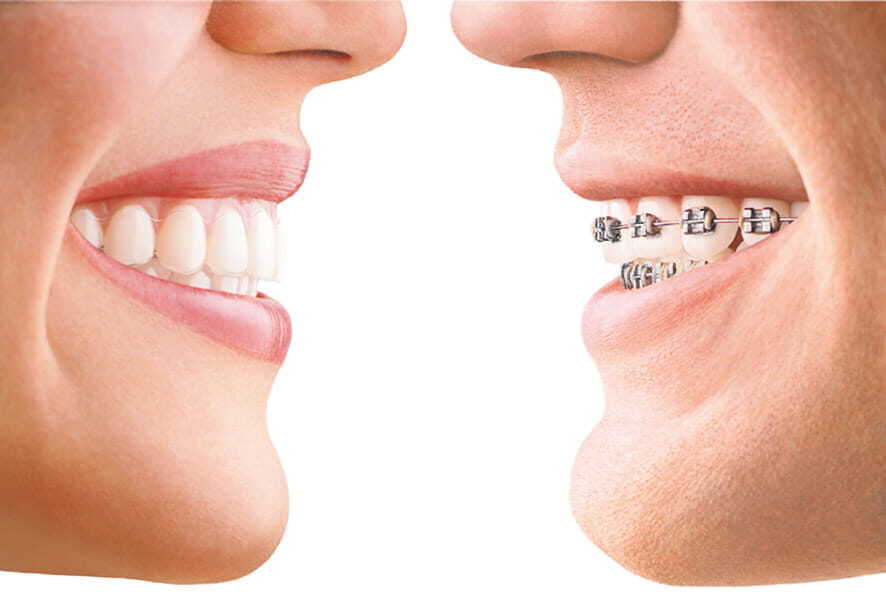
Quick comparison
| Clear aligners | Braces | |
|---|---|---|
| Appearance | Nearly invisible | Visible brackets (ceramic is subtler) |
| Removable | Yes, for eating and cleaning | No |
| Daily wear needed | 20 to 22 hours | Always on |
| Best for | Mild to moderate cases | All cases, including complex bites |
| Food restrictions | None, trays come out | Avoid hard and sticky foods |
| Check-ups | Every 6 to 10 weeks | Every 4 to 8 weeks |
| Typical time | 6 to 18 months | 12 to 24 months |
Advantages of clear aligners
- Discreet, which many adults prefer
- Easier brushing and flossing since trays come out
- Fewer emergency visits for broken wires or brackets
- Often more comfortable, with no metal rubbing your cheeks
Advantages of braces
- Work for more complex problems, including significant rotations and bite issues
- No risk of forgetting to wear them
- Often lower cost
- Well suited to children and teens who may lose or skip aligners
Which should you choose?
Choose aligners if your case is mild to moderate, appearance matters to you and you will reliably wear trays all day. Choose braces if your case is complex, you want the most predictable result or you prefer not to manage removable trays. An assessment with scans will show which options are suitable for your teeth.
Frequently asked questions
Are clear aligners as effective as braces? For suitable cases, yes. For complex bite problems, braces are often more predictable.
Do clear aligners hurt? You will feel pressure for a day or two with each new set of trays, which is a sign they are working.
Do I need a retainer after aligners? Yes, exactly as with braces, to stop teeth moving back.
Find out which option suits your smile. Book a straightening consultation at Melrose Advanced Dentistry in Melrose, Johannesburg: 072 200 1774 or advanced-dentistry.co.za.